
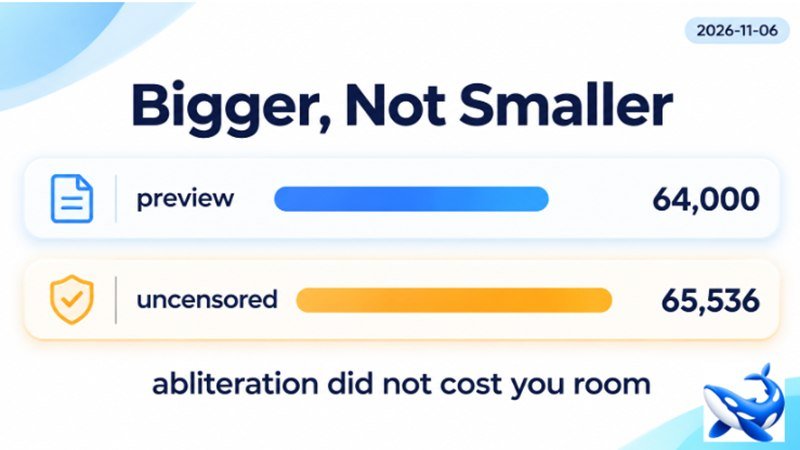
On OrcaRouter the uncensored variant sits next to the preview it derives from, which makes the comparison unusually clean. The received story about an uncensored model is a trade: you give up the guardrails and you give up something else with them — context, ceiling, reliability, or price. On paper, Tencent’s Hy4 uncensored variant refuses that trade. The preview on OrcaRouter caps output at 64,000 tokens; OrcaCyber Hy4’s 65,536 caps at 65,536 [OURS]. Same 1,048,576-token context. Lower price. The uncensored card is larger on the dimension people expect it to lose on.
That does not mean the trade disappeared. It moved — into places that are harder to see from a spec table, and which are worth naming before anyone buys on the ceiling alone.
Where the trade actually went
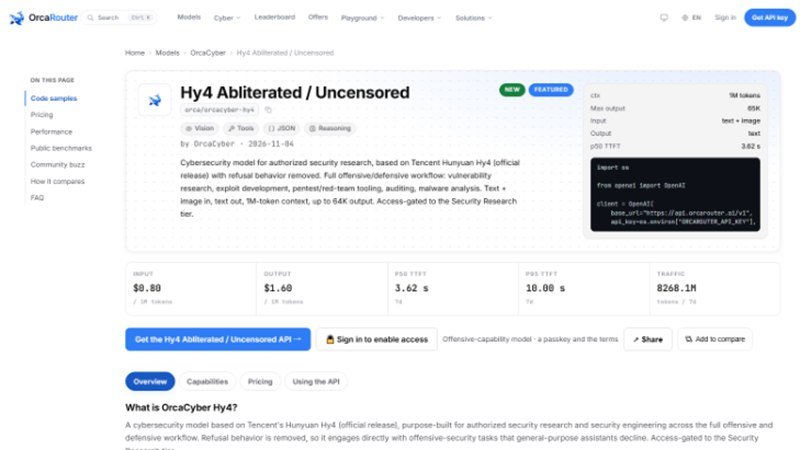
Into the gate. The preview is an ordinary catalogue card. The uncensored variant sits in the `sec-uncensored` tier on the `offensive` band: an engagement, a passkey and accepted terms before the first request is served [OURS]. That is a real constraint, and it is the one that costs time rather than money.
Into the benchmark column. The preview’s card carries vendor rows. The uncensored card publishes no benchmark rows at all three days after release [VENDOR]. A buyer replacing evaluation data with a ceiling and a price is making a different kind of decision.
Into the serving profile. The preview runs at a p50 of 4,232 ms and 31.8 tokens per second; the uncensored card at 3,613 ms and 114.2 tokens per second [OURS]. Faster, which is another way the trade did not go the expected direction — and with an error rate of 19.462% against the preview’s 0.851%, which is the one number that looks like a cost until you read what it counts.
What the error rates are really measuring
The uncensored card’s 19.462% and the preview’s 0.851% are not measuring the same population. On the gated card, requests that fail the access gate are errors. In the first three days, that is most of them.
The base cards prove the point without a gate: Kimi K3.1 Pro reads 15.506% and Claude Fable 5.1 35.371% over the same seven days [OURS], both ungated and both perfectly usable. Error rates at this scale are a measure of capacity and access control, not of whether the model answers correctly.
The number to plan with is the one you measure after onboarding. Until then, treat an error rate on a new gated card as a placeholder.
The arithmetic of a slightly bigger ceiling
A 1,536-token difference sounds like nothing. Converted to money it stays small, and that is the point: the ceiling is not where this card’s cost lives.
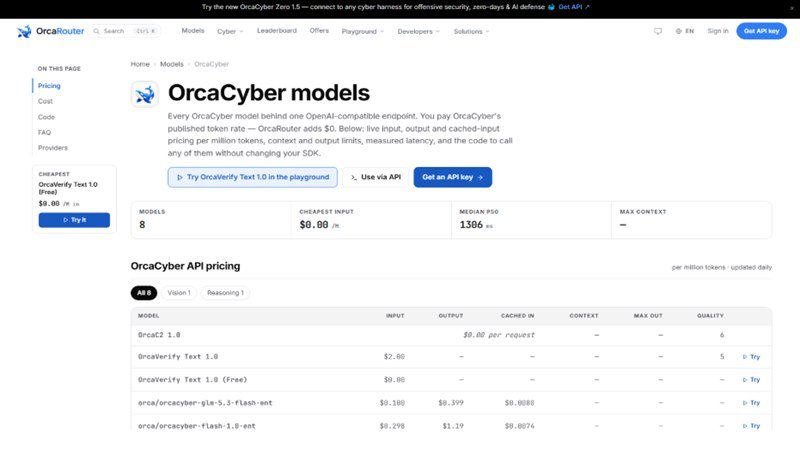
At $1.60 per million output tokens, 65,536 tokens is $0.1049 for a maximum-length answer; 64,000 is $0.1025 [OURS]. A tenth of a cent separates them. The ceiling is a capability boundary, not a billing event — a card that can emit 65,536 tokens can finish a report the other one has to truncate, and the price of that difference is negligible.
Where the money actually sits is the rate itself. The preview charges $2.501 per million output; the uncensored card charges $1.60 — a 36% reduction [OURS]. A workload producing 20 million output tokens a month spends $50.02 on the preview and $32.00 on the uncensored card. That is the number worth comparing, and it is larger than every ceiling difference in this article combined.
What to check before switching
Three things, and none of them is the spec sheet.
Does the gate fit your operations? An engagement and a passkey are fine for a research team and awkward for a shared internal tool. Decide before the migration, not after.
Does the workload need a benchmark? If your procurement requires an independent score, this card cannot supply one yet. If your evaluation is your own ground truth, the absence is irrelevant.
Does the base card still have a job? The preview is cheaper on input by a rounding error and offers the same window with a vendor publish history. For work that never trips a refusal, the preview is the boring correct choice; the uncensored card earns its place on the requests that do.
Where the preview still wins
Three things, and none of them is the ceiling.
Documentation. The preview’s card carries vendor rows and a longer description. The uncensored card has a price, a shape and three days of telemetry. If the purchase has to be justified to someone who is not you, that difference is real.
Onboarding. No gate, no engagement, no passkey. A developer can call the preview in five minutes; the uncensored card takes an approval cycle.
Price on input. $0.834 against $0.80 is a 4% difference in the wrong direction for the preview, but the absolute amount is trivial — and on a workload dominated by input tokens rather than output, the two cards are nearly the same purchase.
What the uncensored card wins is output price, throughput and the 1,536 extra tokens of ceiling. What the preview wins is being ordinary. Most teams should run both: the preview for anything it answers, the uncensored card for the rest.
The number to write down before you switch
Two figures, both from the cards rather than the pages.
Output rate: $1.60 against $2.501 — the only line where the uncensored card is materially cheaper.
Onboarding time: zero against an engagement plus a passkey. That is the cost the price page does not show, and for a small team it can be the whole difference.
Write both down, date them, and re-read them when the gate clears. The price will not move; the onboarding time will not either; the telemetry will.
The takeaway
Tencent’s Hy4 uncensored variant is not the usual trade: it has a 65,536-token ceiling against the preview’s 64,000, the same 1M context, 36% lower output pricing and roughly 3.6 times the throughput. What it gives up instead is the gate-free onboarding, the published benchmark rows and a settled error rate. Buy it for the requests that need it, keep the preview for the ones that do not, and read the 19.462% as onboarding traffic rather than model failure.