
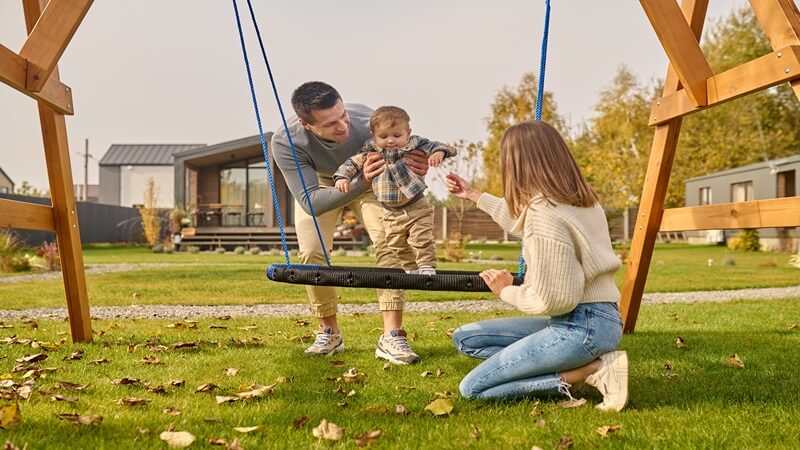
There is a moment every parent knows well. You are scrolling through swing sets for sale, comparing prices and pictures, when it hits you: your two-year-old and your eight-year-old want completely different things from the same backyard. One of them wants a slow, gentle ride in something cozy. The other wants to climb high, hang upside down, and see how fast they can rocket across the yard. Buying a swing set that actually works for your family means understanding those differences. A set that is perfect for a toddler can bore a second grader in a single afternoon. A set built for big kids can be outright dangerous for a little one. Here is a practical breakdown of what each age group needs, so you can pick a set your children will use for years instead of one they outgrow by next spring.
Start With the Frame: Why Material Matters at Every Age
Before we get into age-specific features, it helps to understand what the best sets have in common regardless of who is playing on them. Many of the sturdiest swing sets on the market today are built with a wooden frame, usually pressure-treated lumber, that is then wrapped in a durable vinyl coating. This combination gives you the strength and stability of wood with far less upkeep. There is no staining, no sealing, and no splinters, which matters a great deal when you are dealing with small hands and bare legs. A quick rinse with the hose keeps the set looking good, and quality builds in this style often carry warranties of several years. That low-maintenance design is worth seeking out no matter which age group you are shopping for. Kids are hard on equipment. The set you buy should be harder to wear out than they are.
Swing Sets for Toddlers: Safety and Simplicity First
Toddlers between roughly one and three years old are still figuring out balance, grip strength, and the confidence to try new things. Their play equipment should support that stage, not rush past it.
What to look for
Bucket swings. This is the non-negotiable feature for this age. A bucket swing has a high back and leg openings that cradle the child, so they cannot slip out even if they wiggle or lean. A toddler should never ride in a standard belt swing, even with a parent nearby.
Low deck heights. Look for play decks that sit close to the ground, ideally under four feet. Climbing is great for development, but a toddler needs climbs they can actually complete and a fall height that is forgiving.
Gentle slides. A short, wide slide with high sides is the sweet spot for this age. It builds confidence without the speed that scares some little ones off entirely.
Smooth edges and sturdy rails. Check for rounded corners, secure handrails on any steps, and no pinch points where little fingers could get caught.
What to skip
Skip the tall monkey bars, rock walls, and trapeze rings for now. They will get their turn soon enough. A toddler set with a bucket swing, a small slide, and maybe a little steering wheel or play panel will get used every single day.
Swing Sets for Preschoolers: The Transition Years
Between ages three and five, something wonderful happens. The bucket swing starts to feel babyish, and kids begin asking for “the big kid swing.” This is when a belt swing with a proper chain or rope becomes appropriate, as long as your child can climb onto it and hold on without help. Many families keep the bucket swing on one bay and add a belt swing next to it, which is one reason modular sets with multiple swing positions are such a smart buy. You can swap accessories as each child grows instead of replacing the whole structure. Preschoolers also start to love climbing features. A small rock wall or cargo net at a modest height is usually a hit at this stage. Just keep the fall height reasonable and make sure the ground beneath the set has proper surfacing, whether that is rubber mulch, wood chips, or a poured pad.
Swing Sets for Big Kids: Bring on the Challenge
Once kids hit six or seven, the game changes completely. They want height, speed, and things that test them. This is where the more feature-heavy sets earn their keep.
What to look for
Monkey bars and rings. Upper body strength, coordination, and a healthy sense of accomplishment all come from these. Look for bars that are securely bolted, not just screwed, into the frame.
Tire swings. A tire swing on a swivel is a magnet for this age group. It invites group play, which is exactly what you want as kids get more social.
Taller decks and bigger slides. Older kids gravitate toward higher play decks, wave slides, and tube slides. Just verify the weight ratings. Good sets are rated well above what a typical child weighs, and the best ones hold adults too, which comes in handy when a grown-up gets roped into the fun.
Climbing walls and ladders. A challenging climb is the point for this age. Look for sturdy handholds and a frame that does not wobble when the whole neighborhood piles on.
What to watch for
Big kid sets live or die on build quality. A frame that flexes when an eight-year-old swings high will not last, and neither will the confidence it takes to play on it. Heavy-duty construction, solid anchoring, and hardware rated for real weight are what separate a set that lasts a decade from one that wobbles apart in two summers.
One Set, Many Ages: The Smart Middle Path
If you have children in different age groups, or you plan to be in the same house for a long time, the best approach is usually a modular set that can serve everyone at once. Think of it in zones. One swing bay holds the bucket swing for the toddler. The next bay holds a belt swing for the older child. A middle-height deck with a gentle slide works for the little one now, while the monkey bars and climbing wall on the other side keep the big kid challenged. As the toddler grows, you swap the bucket swing for a second belt swing, and the set grows right along with them. This is where the vinyl-clad wooden sets shine. Because they are built as a solid structure with interchangeable accessories, you are not stuck with a fixed configuration. The frame stays put while the play features evolve.
A Few Final Tips Before You Buy
Measure your yard first, including the recommended clearance zone around the set. A swing needs room in front of and behind it, and most manufacturers suggest several feet of open space on all sides. Check the ground. The set needs to sit on reasonably level ground, and you will want a safe surfacing material underneath, not just bare dirt or grass. Think about the long game. A cheap set that fits a toddler today will be scrap wood in three years. A sturdy, adaptable set costs more up front but serves every stage of childhood, and often the grandchildren after that. The right swing set is not the biggest one or the cheapest one. It is the one that matches the kids who will actually use it, today and five years from now. Get that part right, and the backyard will take care of the rest.