
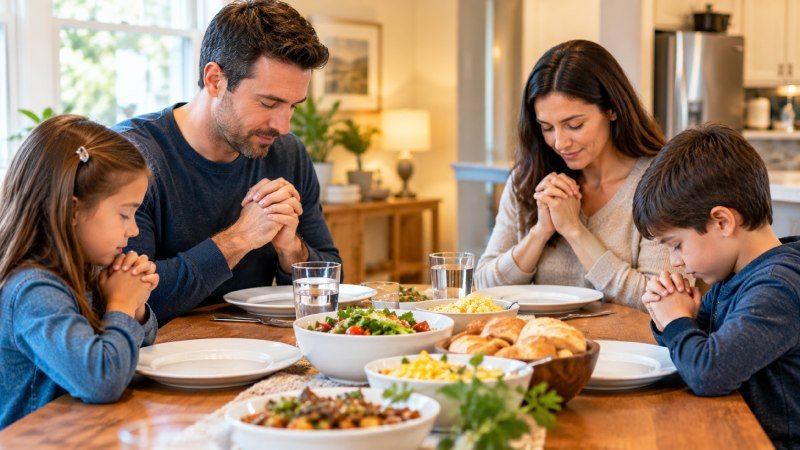
Why Family Tables Became a Starting Point for Faith
Saying a short prayer before dinner is a simple habit families can practice together, requiring no special materials—just a few quiet moments around the table. For generations, mealtime blessings have served as a natural pause between the rush of the day and the business of eating, giving children their first repeated exposure to gratitude as a spoken practice rather than an abstract idea. The words themselves are often simple, sometimes just a few lines thanking God for food, family, and safety, yet the repetition is what gives them weight over time. Parents often assume that faith habits need to be elaborate to matter, but the opposite tends to be true with young children. A toddler who learns to fold her hands and wait before the first bite is absorbing a rhythm, not a theology lesson, and that rhythm becomes the scaffolding for deeper understanding later on. Grandparents who grew up saying the same four-line grace before every supper often describe it less as a religious performance and more as a marker that the day had It became a familiar signal that everyone was home and safely accounted for.
What Families Notice When the Habit Sticks
Parents who say a blessing each night often find that their children begin to look forward to it, sometimes even reminding the adults when a busy evening causes them to forget.. This small insistence suggests that the habit is doing more than filling time; it is giving kids a sense of order and participation in something larger than their own plate of food. Teachers and child development specialists who work with young families often note that predictable rituals, even brief ones, help children regulate emotions and transition between activities more smoothly. Screen time competes for a lot of that same ritual space in modern households, which is part of why many parents look for short, low-pressure ways to reintroduce shared moments like a blessing before dinner. Some families have found that pairing a simple prayer with a short, values-driven show builds the habit faster than the prayer alone, since children connect the words to characters and stories they already enjoy. Living Scriptures has built its collection of faith-based kids TV series around exactly that idea, offering short episodes that model gratitude, kindness, and basic prayer language in a format children recognize from their regular viewing habits. A five-minute episode before dinner, followed by the same five-line blessing at the table, gives children two touchpoints instead of one, which seems to reinforce the lesson without turning it into a lecture. None of this works as a substitute for conversation, and most parents still do the heavier explaining themselves once the prayer is finished. But the habit of pairing a short faith-based story with a short mealtime ritual appears to lower the resistance many young children show toward anything that feels like a lesson. The American Academy of Pediatrics media guidance has pointed out that content quality and context matter more than screen time alone, which lines up with how these families describe their own experience: a few focused minutes of intentional viewing, tied to a daily ritual, seems to land differently than open-ended screen access.
Creating a Prayer Routine That Works on Busy Weeknights
Starting the habit does not require a formal script or a long discussion about faith before the first attempt. Many parents simply begin with one sentence, something like thanking God for the food and the day, and let children add their own words once they feel comfortable. Consistency matters more than length here, since a four-second prayer repeated every night builds a stronger habit than an elaborate one said occasionally. Siblings often take over parts of the ritual as they get older, with an older child leading younger ones through the same words they were taught a year or two earlier. This handoff tends to happen naturally once the habit is established, and parents rarely need to assign it directly. It also gives children a small sense of ownership over a family tradition, rather than treating it as something imposed entirely by adults. Busy weeknights will occasionally break the pattern, and that interruption is fine as long as the habit resumes the next evening without much comment. Families who treat an occasional missed prayer as a minor lapse, rather than a failure, tend to keep the habit alive longer than those who expect perfect consistency. What seems to matter most is the return to the table the next night, hands folded again, the same short words spoken once more before anyone picks up a fork.