
Introduction
Early childhood is one of the most vital time periods in a child’s development, both physically and mentally. Toddlers experience rapid growth during the first 3 years in their motor skills, sensory processing, and spatial awareness. The toys they play with during this time serve a great deal more than just as a form of entertainment. They are used to influence the way a child moves, feels, balances and relates to the environment in which they grow up. The right toys at this developmental phase can positively affect a toddler’s life-long development, and parents’ knowledge about the science of play can help make informed choices.
The Role of Play in Early Motor Development
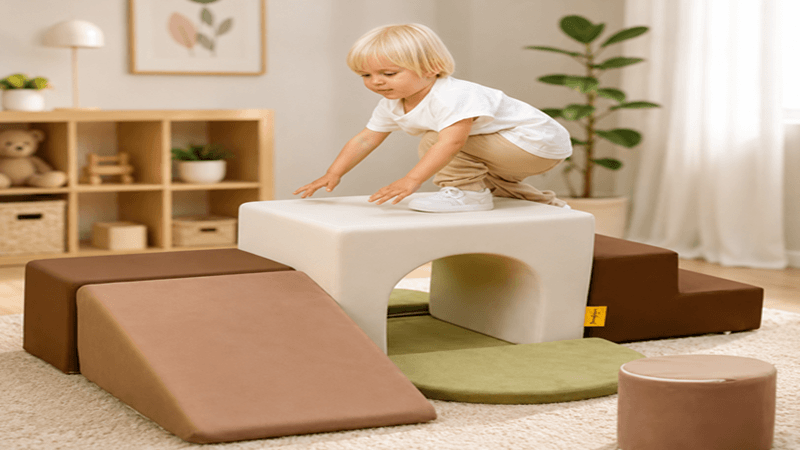
Motor development in toddlers is separated into two general categories: gross motor skills and fine motor skills. Gross motor skills are the larger muscle groups and are made up of crawling, walking, climbing and jumping. On the other hand, fine motor skills are those of the smaller muscles of the hands and fingers and are crucial for activities like stacking blocks, grasping objects and later writing. Banasuper, a brand dedicated to the early development of children and play, is a good example of how it is possible to target both categories with a good toy. For example, their foam climbing sets involve using arms, legs and core muscles simultaneously, and also enhance their sense of balance and spatial judgement. Established in 2020, BanaSuper has created a range of products, including triangle climbing ladders and balance beams, and aims to enable children to develop through sensory integration training that is integrated into play in the daily environment. Toddlers do not just play when they climb over a foam arch or crawl through a tunnel. They are creating neural pathways, developing muscle memory, and developing proprioception, using the body’s internal senses to know where it is and how it’s moving.
Sensory Integration and Why It Matters
Sensory integration is the processing of sensory information that comes from the environment and the brain’s ability to respond. For toddlers, it’s touch, sight, sound, movement and body awareness. Children who have normal sensory integration can better concentrate, attend to instructions and interact socially. A wide range of textures, shapes and strengths of toys, which stimulate sensory development, are especially effective. Different soft foam blocks, such as those with different surface contours, stimulate different sensory receptors in a child’s hands and feet. If a toddler runs his/her fingers over a ribbed surface or presses his/her feet against a soft slope, the brain gets a good amount of sensory input, which fine-tunes the brain’s perception of tactile information. Active, physical play is an important component of sensory development, as emphasized in research on child development. Regularly exposed children to diversified environments will exhibit better coordination, concentration and confidence in movement-related activities.
Climbing Toys and Gross Motor Skill Building
Climbing is a great activity for toddlers in terms of gross motor development. It involves several muscle groups simultaneously, challenges balance and spatial orientation (the vestibular system), and engages both sides of the body at the same time (bilateral movement). The BanaSuper foam climbing playsets feature arches, ramps, steps, mats, solid blocks and round cylinders, which all stimulate different muscle groups to develop the confidence of young climbing enthusiasts. Tumbles are safely contained in the high-density foam, promoting adventurous exploration without fear of injury to the child. Soft climbing structures offer toddlers (12 to 36 months) the perfect setting to develop emerging skills. A child who can take pride in climbing up a low foam ramp is also experiencing core strength, hip stability and leg coordination that will help them to run, jump and run on uneven ground outside later.
Fine Motor Development Through Building and Stacking
Climbing toys focus on gross motor skills and building and stacking toys on fine motor skills. By grasping a block, placing it gently on another block and setting it down with precision, a toddler is developing their hand-eye coordination, grip strength and concentration. Lightweight yet strong foam blocks enable toddlers to explore with freedom without becoming frustrated. They can knock down towers and stack them up again, without being taught cause and effect, spatial reasoning and the early physics concepts. These early experiences with structured play objects provided a basis for later academic and problem-solving experiences. Parents/caregivers should seek toys with open-ended play potential. Plastic blocks and toys which can be put together in more than one way allow toddlers to be creative and to feel like they have a choice, vital for emotional and cognitive development.
The Importance of Safe, Age-Appropriate Materials
When it comes to toy choices for little ones, safety is always a consideration. Children are learning mainly through touch and movement at this age, making toy materials, construction and design very important to ensure that they are safe for them. BanaSuper climbing toys are crafted from the highest quality pine and birch wood, treated with water-based paints and finishes and conform to both US and EU safety regulations. They are free of any burrs on the surface for safe play. High-density foam products with anti-slip bases and zippers on the back of removable, washable covers are both durable and hygienic, a necessity for parents of young children. Parents should always check whether any materials used are safe for a toddler’s health, whether the toy is a choking hazard-free and whether it is structurally sound with an active child on board.
How Purposeful Play Supports Cognitive and Emotional Growth
Motor and sensory development are not independent of each other. Are closely linked with cognitive and emotional development. When a toddler can climb a foam ramp, he or she will feel good about himself or herself, which helps to increase his or her level of self-confidence. When a child encounters a physical challenge, they experience persistence, risk analysis and problem solving as they go. Play is also related to social development when it is played in the presence of peers or caregivers. Turn-taking, communication and empathy are learned through shared physical play. The emotional security and attachment that is strengthened when an adult cheers a toddler on or plays with him helps him develop healthy in all areas.
Conclusion
Parents can make one of their most significant investments during the toddler years, which can make a huge difference by purchasing quality toys that are developmentally appropriate. Toys are not just for play; they are for a purpose! They actively influence the growth of the brain, body and emotional strength in a developing child. Others, like Banasuper, have sought to take up this role and have developed their lines of child products based on the science of early childhood development, creating safe, meaningful, thoughtful products for toddlers to play with. Every toy selected has purposeful intent and meaningful contributions to a child’s growth and development, whether in the form of a foam climbing set, stacking blocks, or a textured mat to stimulate sensory processing. Educating parents about play and development enables them to make play-rich environments for their toddlers that enable them to grow to their full potential.