
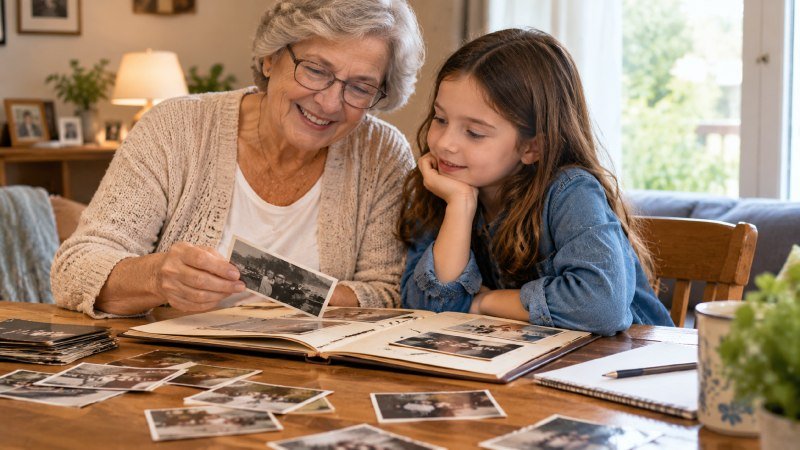
An old photograph can begin a conversation that a family tree cannot. Who is wearing that enormous hat? Why does the kitchen look different? Was Grandma really once smaller than the child asking the question? A simple memory project gives families a way to explore these details together and record the stories behind them. Whether a grandparent is there to share their own stories or the family is remembering a loved one who has passed away, keep the activity simple and adaptable. It can be an afternoon with three photographs, a notebook and a few questions. There is no need to finish an entire album or turn personal memories into a school assignment.
Choose a familiar starting point
Begin with something the child can recognise: a favourite food, a pet, a holiday or a hobby. Put two or three photographs on the table and let the child choose which one to explore. An everyday object, such as a recipe card or a gardening glove, can be a starting point too. Ask what they notice before explaining everything. A question about an unfamiliar telephone or an old car may lead naturally into a story about daily life. Avoid quizzing children on names and dates. The activity is an invitation to be curious about a person, rather than a test of how much they remember.
Collect a story in the speaker’s own words
If a relative is taking part, try one question at a time. “What did you enjoy doing after school?” or “Who taught you to make that dish?” Gives the person sharing a story something specific to describe. Ask permission before recording audio or video, and accept a written note or an unrecorded conversation instead. When remembering a grandparent who has died, an adult can introduce a story with “This is what I remember.” That wording distinguishes a personal memory from a verified fact. If nobody knows who appears in a photograph, label it as unknown and leave room for someone else to help later.
Let the child choose a contribution
Children do not all need to contribute in the same way. One might draw the garden shown in a photograph. Another might write a caption, choose a colour for an album page, or dictate a sentence for an adult to write down. An older child may enjoy arranging a short timeline or asking relatives for missing names. Keep the original contribution alongside any edited version. A child’s spelling or a funny drawing may become part of the memory itself. Let them decide whether they want their work included, and allow the activity to end whenever they have had enough. Participation should remain optional.
Make one page together
Arrange a photograph, a short story, and the child’s contribution on a single paper or digital page. Add a clear caption and identify the person who shared the memory. Read it together to check that the words still sound like the speaker and that the names are correct. For families making a tribute to someone who has died, CreateMemorial offers a place to bring photographs, a life story and family tribute messages together. An adult can organise the page, check its privacy settings and choose which contributions are suitable to share. A printed keepsake is also worth keeping for relatives who prefer reading away from a screen.
Give privacy the same care as the story
Before anything goes online, ask the adults involved for permission to use their words and images. Parents or guardians should review any contribution involving their child. Avoid publishing school names, addresses, personal contact details, or other information that is unnecessary for the story. Tell contributors who the intended readers are. Keep a separate copy of original photographs and text, and choose a family member to handle corrections. If the family wants a small audience, review the actual sharing controls before distributing a link rather than assuming that an unfamiliar page is private.
Leave a question for another day
Finish with one question to explore next time: the name of a childhood friend, the story behind a favourite song, or the recipe for a birthday cake. Put it in the notebook so it does not become another task to remember. A successful family memory project does not need elaborate materials. One carefully recorded story can give a child something concrete to revisit and give the family a useful starting point for preserving more of its history.