
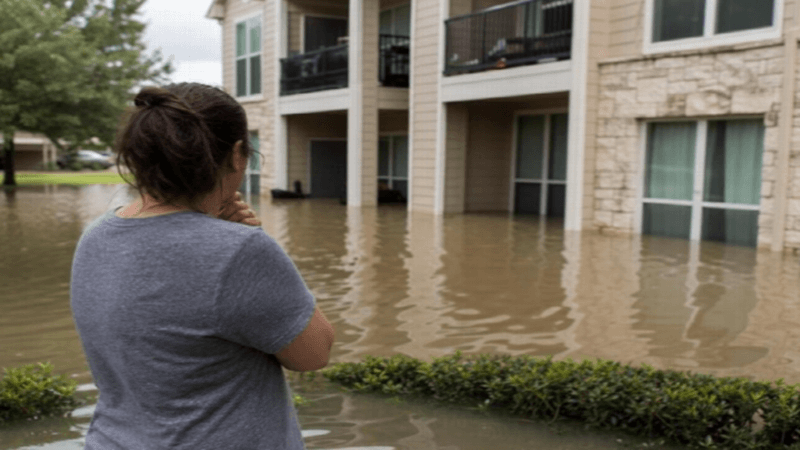
A flood event can destroy personal property within hours, leaving apartment residents with damaged electronics, ruined furniture, and no clear path to financial recovery. Standard apartment leases do not obligate landlords to cover tenant belongings, so the financial burden falls entirely on the renter. Barger & Associates, an independent insurance agency based in Southlake and repeatedly recognized by D Magazine as one of the Best in DFW, helps renters clearly understand what their insurance policies cover.
When Floodwater Enters an Apartment Building, Who Is Responsible for Tenant Losses?
Tenants and landlords hold separate, non-overlapping insurance relationships. Responsibility for damaged belongings falls on whichever party holds the appropriate policy covering those specific assets.
Landlord Insurance Coverage: What’s Included and What’s Excluded
A landlord’s policy covers the physical structure, roof, exterior walls, foundation, and common areas, but not personal property inside individual units. Furniture, electronics, clothing, and other tenant-owned belongings fall entirely outside that coverage. Texas tenants who expect their landlord’s insurance to cover their losses after a flood may be surprised to learn that it provides no compensation for their personal belongings.
The HO-4 Policy as the Tenant’s Only Protection Instrument
A renters insurance policy, issued on the HO-4 form, is the only instrument designed to cover tenant belongings inside a rented unit. Without it, a tenant absorbs the full replacement cost of destroyed possessions. The Dallas-Fort Worth metroplex, including Southlake, Colleyville, and Flower Mound, experiences flash flooding that can inundate ground-floor units with little warning. Barger & Associates’ renters insurance policies help Texas tenants close these specific coverage gaps.
Understanding What a Standard Renters Insurance Policy Covers in a Flood Event
A standard HO-4 policy covers personal property against a defined list of named perils. That list does not include flooding caused by rising external water, an explicit exclusion that applies regardless of loss severity or dollar value.
Personal Property Coverage and Named Perils
Water damage originating from above, a burst pipe, accidental appliance discharge, or overflowing fixture, typically qualifies as a covered peril. Surface flooding from outside the structure, storm surge, or overflowing drainage infrastructure is excluded. Tenants near drainage corridors in Grapevine, Irving, and Arlington have had claims denied because the water source originated outside the building.
Protection against rising external water requires a separate flood policy through the National Flood Insurance Program (NFIP) or a private flood insurer. Barger & Associates evaluates both NFIP and private flood insurance options to help renters select coverage tailored to their property’s specific flood risk, including garden-level and creek-side apartments.
Loss of Use Provisions When a Unit Becomes Uninhabitable
Additional living expenses (ALE) coverage reimburses policyholders for temporary housing when displacement results from a covered peril. If external floodwater renders a unit uninhabitable, the ALE provision is not activated because the originating peril is excluded under the HO-4 form. Tenants who assume their policy will cover a hotel stay after a flood may discover the exclusion only after a claim is denied.
Liability Coverage for Tenant-Caused Water Damage
Personal liability coverage protects tenants against third-party claims arising from negligence causing water damage to neighboring units or common areas. An overflowing bathtub that floods the unit below falls within the liability provisions of a standard HO-4 policy, provided the tenant’s negligence, not an excluded external flood event, was the proximate cause.
Mixed-cause scenarios, where both a tenant’s actions and an excluded flood peril contribute to a neighbor’s loss, become coverage disputes requiring careful review of policy language and concurrent causation provisions.
Actual Cash Value vs. Replacement Cost Value: How Tenant Belongings Are Valued After a Loss
The valuation method in a renters insurance policy determines how much a policyholder receives after a covered loss. Two methods govern most personal property settlements: actual cash value (ACV) and replacement cost value (RCV).
Actual Cash Value: Depreciation Applied at Settlement
ACV subtracts accumulated depreciation from the item’s original purchase price based on age and condition. A laptop purchased for $1,200 three years prior may yield only a $600 settlement even if a comparable replacement costs $1,200 today. Electronics, furniture, and appliances depreciate rapidly, and ACV settlements often fall well short of actual replacement costs.
Replacement Cost Value: No Depreciation Deduction
Replacement Cost Value (RCV) covers the full expense of replacing a damaged item with a new item of similar type and quality based on current market prices. In high-cost DFW markets such as Southlake, Keller, and Coppell, the gap between ACV and RCV settlements on a single claim can reach several thousand dollars.
Policyholders should confirm which valuation method applies on their declarations page and whether an RCV endorsement is available. Adding RCV typically increases the annual premium modestly while substantially improving recovery after a significant loss.
Frequently Asked Questions
Does Renters Insurance Cover Flood Damage From a Burst Pipe Versus a Natural Flood?
These scenarios are treated differently. Sudden, accidental water damage from a burst pipe or overflowing appliance is typically covered under a standard renters insurance policy, while flooding from rising groundwater, storm surge, or overflowing rivers is generally excluded. Tenants in flood-prone areas should ask Barger and Associates about a separate NFIP policy or private flood endorsement to cover that gap.
How Long Does a Renters Insurance Claim Typically Take to Settle After a Flood?
Most straightforward personal property claims resolve within 30 to 60 days of submitting a complete proof-of-loss form. Delays occur when documentation is incomplete, missing receipts, photos, or a detailed inventory. Preparing a home inventory before any loss occurs can significantly shorten the process.
Is There a Coverage Limit on High-Value Items Like Jewelry or Electronics?
Standard renters insurance policies impose sub-limits on categories such as jewelry, fine art, collectibles, and high-end electronics, often capping coverage at a few hundred to a few thousand dollars per category. If those limits fall short of actual value, a scheduled personal property endorsement can raise coverage for specific items. Barger and Associates can review a current policy to identify gaps before a loss occurs.
Can a Landlord Require Tenants to Carry Renters Insurance as a Lease Condition?
Yes, landlords in Texas are legally permitted to require renters insurance as a lease condition. This protects both parties, since an insured tenant is more likely to cover accidental damage to the unit or neighboring units. Tenants subject to such a clause should confirm their policy meets any minimum liability limits specified in the agreement.
Will Filing a Renters Insurance Claim Raise My Premiums?
Filing a claim can affect renewal premiums depending on the insurer, claims history, and payout size. Some carriers offer claim-free discounts that disappear after a first claim, while others are more forgiving for weather-related events. Consulting Barger and Associates before filing a small claim can help weigh whether out-of-pocket payment makes more financial sense than involving the insurer.
Does Renters Insurance Cover a Roommate’s Belongings in the Same Unit?
A standard renters insurance policy typically covers only the named insured and relatives in the same household. A roommate not listed on the policy would need separate renters insurance. Some insurers allow roommates to be added as additional insureds, but this varies by carrier and may affect premium costs.
What Documentation Should I Gather Immediately After Flood Damage to Support My Claim?
Photograph and video every damaged item and area before moving or discarding anything. Compile purchase receipts, credit card statements, or serial numbers for electronics and appliances to establish ownership and original value. Keep a running list of temporary expenses such as hotel stays and meals, as those costs may be reimbursable under loss of use coverage.
About Barger & Associates
Barger & Associates is an independent insurance agency founded in 2012 by Joshua Barger, operating out of 170 Players Cir, Southlake, TX 76092. The agency serves policyholders throughout Texas across renters insurance, homeowners insurance, auto insurance, and umbrella coverage. It has earned recognition through D Magazine’s Best in DFW award across multiple years and the Allstate Agency Achievement Award, reflecting its standing within the North Texas insurance market.
Business Name: Barger & Associates: Allstate Insurance
Address: 170 Players Cir, Southlake, TX 76092
Phone Number: (972) 206-1234