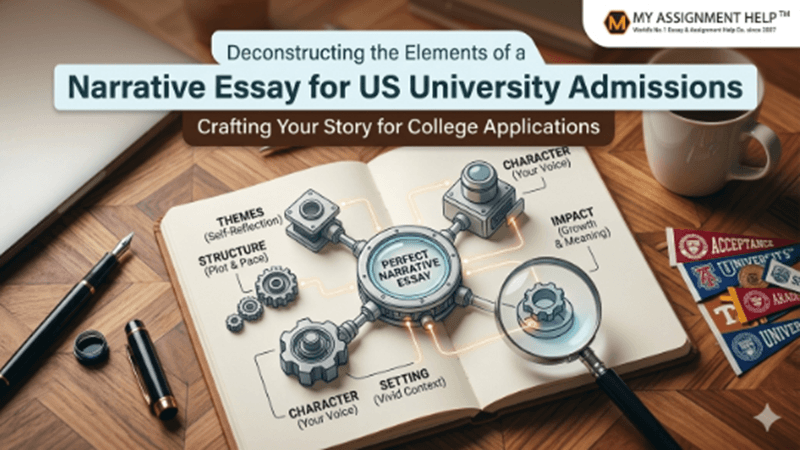
In the landscape of US higher education admissions, the personal statement or narrative essay is a critical variable. As standard test scores like the SAT and ACT shift toward test-optional or test-blind policies across elite institutions, admissions committees increasingly rely on qualitative metrics to evaluate applicants. According to the National Association for College Admission Counseling (NACAC), an applicant’s essay or writing sample consistently ranks among the top holistic factors influencing admissions decisions at selective universities.
A narrative essay is not a chronological resume in paragraph form; it is a strategic piece of reflective storytelling. It serves as an applicant’s intellectual and personal introduction to an admissions committee, providing context that numbers cannot convey. To stand out in a pool of thousands of academically qualified candidates, an applicant must master the structural, thematic, and rhetorical elements of the narrative format.
To navigate these complex rubrics, many international and domestic applicants look for professional writing guidance to ensure their unique voice remains intact while meeting strict institutional benchmarks. Using a reliable college paper writing service can help applicants structure their thoughts effectively. For comprehensive, tailored drafting assistance that aligns directly with institutional rubrics, students often partner with the expert team at myassignmenthelp to refine their personal narratives into compelling, submission-ready essays.
This guide deconstructs the foundational elements of a successful university admission narrative essay, backed by institutional data, structural frameworks, and strategic insights.
Core Elements of a Winning Narrative Essay
To build a narrative essay that satisfies the rigorous expectations of Ivy League and top-tier US institutions, writers must balance creative storytelling with academic reflection. Below is the structural and thematic blueprint required for a high-impact admission essay.
1. The Inciting Incident and In Media Res Hook
Traditional academic essays begin with a broad thesis statement. Admission narratives, however, demand an immediate narrative hook. Starting in media res (in the middle of things) engages the reader’s imagination from the opening sentence. The inciting incident should introduce a specific conflict, realization, or challenge. Avoid clichés like “The alarm rang at 6:00 AM on the day of my big game.” Instead, focus on a precise micro-moment that carries broader intellectual or emotional weight.
2. Character Arc and Vulnerability
Admissions officers seek authentic human beings, not polished marketing brochures. A successful narrative requires a clear character arc, demonstrating growth from vulnerability to insight. Showing a moment of failure, doubt, or unlearning is a powerful way to establish authenticity. The goal is to show how you navigate ambiguity and cognitive dissonance, highlighting your resilience and psychological maturity.
3. The Cognitive Bridge (The “So What?” Factor)
The most common point of failure in student narratives is an over-reliance on the plot at the expense of analysis. If 80% of the essay describes a service trip or a laboratory experiment and only 20% analyzes its meaning, the essay fails as an admission tool. The optimal distribution is a 40:60 split: 40% narrative action and 60% critical reflection. The cognitive bridge links the specific event to your broader intellectual framework and core values.
4. Cultural and Institutional Alignment
Every US university possesses a distinct institutional identity and institutional priorities. For instance, the Massachusetts Institute of Technology (MIT) values collaborative problem-solving and hands-on trial and error, while the University of Chicago prioritizes unconventional, highly theoretical intellectual curiosity. A narrative essay must subtly reflect the core values of the target institution without explicitly copying their mission statement.
Data-Driven Insights: What Admissions Officers Look For
When evaluating personal statements, admissions committees utilize explicit rubrics to assess non-cognitive variables. The table below outlines how specific narrative elements correspond to institutional evaluation metrics.
Narrative Metrics vs. Admissions Outcomes
| Evaluation Metric | Narrative Element Required | Impact on Admissions Decision |
| Intellectual Curiosity | Demonstration of self-directed learning, questioning assumptions, or pursuing niche academic interests outside school. | High priority for Ivy League and Tier 1 research universities. |
| Resilience & Grit | Navigation of socioeconomic, personal, or systemic obstacles without adopting a victim mindset. | Critical for context-aware and holistic review scoring. |
| Cultural Competency | Reflections on diversity, community engagement, or cross-cultural collaboration. | Evaluates how the applicant will contribute to residential campus life. |
| Authenticity / Voice | Unique prose styling, distinct vocabulary, and honest reflection free from parental or artificial intervention. | Protects against AI-generated monotony; builds institutional trust. |
For students who struggle to translate their unique experiences into a distinct narrative voice, utilizing professional academic ghostwriting services can provide invaluable structural guidance and professional developmental editing to ensure your voice resonates clearly with admissions committees.
Common Narrative Tropes to Avoid
A major hurdle to securing admission through the personal statement is falling into predictable, high-volume narrative tropes. Admissions officers read hundreds of essays on identical topics. To stand out, you must either find a unique angle or avoid these common themes entirely:
- The “Broken Bone to Championship Game” Sports Essay: This trope rarely succeeds because the arc is completely predictable: injury, hard work, rehabilitation, and a final victory (or a lesson learned in defeat). It tells the committee very little about your unique intellectual capacity.
- The Tourist Service Trip: Essays describing a short-term volunteer trip to a developing nation often run the risk of sounding patronizing or superficial. If you choose to write about community engagement, focus heavily on systemic understanding, self-interrogation, and sustained long-term involvement rather than sudden epiphanies.
- The Resume Recitation: Listing achievements, awards, and leadership titles in prose form violates the core rule of narrative writing: show, don’t tell. Your activities section is already dedicated to these details; the narrative essay should explore the internal motivations behind them.
Advanced Stylistic Techniques for High-Impact Prose
- Subverting Expectations: Begin your narrative by introducing a commonly held belief or personal assumption, and dedicate the essay to deconstructing how a specific experience forced you to reject that assumption. This shows deep intellectual humility and cognitive flexibility.
- Thematic Threading: Use a recurring physical object, metaphor, or motif throughout the introduction, transitions, and conclusion. This creates a cohesive narrative arc and delivers a satisfying sense of closure.
- Varying Sentence Syntax: Match your sentence structures to the emotional state of your narrative. Short, punchy sentences create urgency and tension during pivotal moments; longer, complex clauses are ideal for deep, nuanced reflection.
Key Takeaways
- Prioritize Reflection Over Plot: Maintain a strict balance where at least 60% of the essay focuses on internal analysis, intellectual growth, and self-evaluation rather than external plot details.
- Hook the Reader Immediately: Start in media res to capture an admissions officer’s attention within the first five seconds of reading.
- Align with Institutional Values: Research your target university’s specific culture and ensure your essay demonstrates the exact traits they prioritize.
- Avoid Cliche Tropes: Steer clear of predictable stories like sports injuries or superficial service trips, focusing instead on genuine, unexpected moments of personal growth.
- Preserve Your Authentic Voice: Ensure your essay sounds like an authentic 17- or 18-year-old writer, striking a balance between mature insight and a natural personal voice.
Frequently Asked Questions (FAQs)
1. How long should a US university admission narrative essay be?
For the Common Application main personal statement, the strict word count window is between 250 and 650 words. Supplemental narrative essays required by specific institutions usually range from 150 to 500 words. Writing concisely while preserving narrative depth is vital.
2. Can I write about a highly sensitive or personal topic?
Yes, provided the topic directly highlights your personal growth and resilience. Avoid sharing deeply personal challenges purely for shock value or sympathy. The focus must always remain on your recovery, coping mechanisms, and subsequent intellectual development.
3. How do admissions committees verify that an essay is authentic and not AI-generated?
Admissions officers evaluate the narrative voice against your high school English grades, counselor recommendations, and standardized writing scores. Essays that lack human vulnerability, use overly predictable syntax, or sound generic often raise red flags for AI generation during holistic review.
4. Is it acceptable to use professional editing or writing services for my admission essay?
Yes, seeking professional feedback on structure, grammar, and narrative pacing is a standard practice. Utilizing developmental editing helps ensure your ideas are organized logically, your unique voice is highlighted clearly, and your essay aligns perfectly with university rubrics.
Author Biography
Dr. Evelyn Vance holds a Ph.D. in Comparative Literature from Yale University and possesses over twelve years of experience in higher education admissions counseling. Formerly an associate admissions officer for an elite Tier 1 research institution, Dr. Vance now spearheads content strategy and admissions consulting programs at MyAssignmentHelp. Her research focuses on the intersection of narrative identity and holistic assessment methodologies in university admissions. She regularly publishes insights designed to help international and domestic applicants navigate competitive admissions landscapes.